Reproductive Choices, Chapter 5.

Chapter 5 covers how to prevent pregnancy, infection or diseases, and how to practice safe sex. It covers some of the advantages and disadvantages of birth control, which method to choose, awareness for behavioral and fertility awareness. While this chapter does not relate to my health aspect of living a healthy life style through eating clean and exercise, it does relate to me as a women.

I have taken hormonal contraception (birth control pills) since I was 18. I was reluctant to take any type of birth control in fear that it would affect my ability to have children when I was older. “Hormonal contraception alters a women’s biochemistry, preventing ovulation from taking place and producing changes that make it more difficult for the sperm to reach the egg if ovulation occurs” (105). I had started taking the pill because the cramps I was getting were so bad I was missing 2 or 3 days of school once a month! The guys in this course definitely think I’m dramatic, but ladies I know you can relate. For me, the pill helped significantly with my life. “Other potential side effects include change in sexual desire, acne, weight gain, and hair loss or growth” (105). As I mentioned in one of my earlier blogs, I did struggle with unhealthy body image issues from middle school into early high school. Knowing that I could gain wait from the pill was a main reason that I did not want to take it. Looking back, now knowing that pill did not negatively effect me, I maybe would have started it sooner.

Fast forward 4-ish years, and I switched over to the more convenient IUD. “The intrauterine device is a small, plastic, flexible device with a nylon string attached that is places in the uterus for through the cervix and left there for 3 to 10 years” (110). The most painful, horrible, regrettable experience in all my 22 and a half years of life. While, my day to day life has been some what the same, my cramps every month are worse than they have ever been, and getting the device made me pass out. The chapter explains that IUD’s are safe, effective, and reversible with little to no delay of fertility. The chapters disadvantages explain that the side effects go away after a few months, mine have not. I would however recommend the device because of its effectiveness and its truly hassle free once its in.

Touching back on fearing of not being able to have kids… I think this is something many women as they grow up think about. I am in a relationship where I could see myself getting married, having kids, and being happy. Which was also why I got the IUD to have those things happen, (as long as everything works as advertised) on my terms. “An estimated 1 in 10 American couples experience infertility, usually defined as the inability to conceive after trying for a year or more (125). My parents had trouble having me and had to go through IVF which was why I am an only child, and fear that this will happen to me. Chapter 5 talks about the primary causes of infertility which is good to learn. Endometriosis, pelvic inflammatory disease and treatments for these two.

In regards to my health aspect, I considered almost a year ago to stop taking any sort of birth control so my body wasn’t being pumped with un natural hormones. That would have maybe been a bad idea, so I am glad that I didn’t. I think that the side effects that birth control has is outweighed by its advantages. I continue to live my healthy life style, working out, eating clean, and making smart reproductive choices that are best for me. This week I was able to work out 6 days, I ate wholesome meals, and smart choices when going out to eat (I got the salad, but also had the parmesan truffle chips… balance). I felt good, my energy was up, and I noticed an improvement in my quality of sleep and my ability to wake up in the mornings.
Chapter 4: relationships

Relationship are a key factor to our happiness. When our relationships aren’t successful around us, it is difficult to be a happy person. “Two qualities important to any good relationship are accountability and self-nurturance”(73). The chapter talks a lot about the different types of good and bad relationship and what distinguishes one from the other. Accountability is taking responsibility for our action, something I struggle with and have struggled with in relationships. Self nurturance is learning to appreciate yourself.

Having a relationship with my family is so important to me, I feel that I have had less of a relationship as I got older. I grew up as an only child, and feel that was a disadvantage for me. “Family of origin, those in our household during our first years, that we initially learn about feelings, love, problem solving, intimacy, and gender roles” (73). While I learned a lot of those things, I never had the chance to learn about other peoples feelings growing up since everyone at home always seemed to respond to my feelings, my parents were my friends.

I loved learning about how to have successful relationships. Predictability, dependability, and faith. The unhealthy vs healthy relationship chart on page 76 showed me how some relationships that I had thought were healthy may not have been. And also how I may have been an unhealthy person in a relationship. I think a lot of people, including myself fall into the category of neglecting yourself and focusing only on the other person. Another feeling I had a lot was feeling trapped, I knew a relationship was bad, but didn’t know how or when to get out. Looking a the Positive side of the chart, I see how far I have come in my relationships. Communication is the biggest achievement I have made making it a goal to have in all of my relationships. I have gone from a horrible romantic relationship to a healthy, happy, life changing one. Through it I made new friends, and truly learned to love myself. This chapter meant a lot to me, and showed me how far I have come.

In regards to my health aspect, while this doesn’t directly relate with eating healthy… I have had a better relationship with food and how I have felt about my body since starting better relationships. It helps to have a positive support system that supports your goals instead of making you feel like nothing will be good enough.

Chapter 3, Stress.

“Stress is the mental and physical response and adaptation by our bodies to the real perceived changes and challenges in our lives” (50). Stress is the most common feeling that I think humans have in their day to day life. I for one, will feel stressed at minimum once a day. Throughout the chapter I found it interesting to learn about the different types of stress including the positive stressors in our life. “Eustress, or positive stress, presents the opportunity for personal growth and satisfaction and can actually improve health” (50). I’d say that in the last week, I have felt a good amount of eustress. I recently joined a new “gym” (I put in quotes because it is more of a fitness studio where we do pilates style workouts, but it is considered a high intensity yet low impact). I have truly found a work out that challenges me and I look forward to doing. My stress come from finding the time to get to the classes, knowing I may have to stay up later, wake up earlier, or squeeze it into my busy schedule knowing that I will feel amazing once its done. I have gone to 6 classes so far in the last 3 weeks, and have set a schedule to try and get to as many classes as I can in the month!

I can relate to the chapter when it speaks on how stress can effect our sleep. When I am stressed, I don’t sleep. I toss and turn all night, even when I am prepared for the morning, nothing seems to help. I have made it a goal to try to get to bed earlier, and when I feel ready to go to sleep that I don’t use my phone to “unwind” as it makes it much more difficult (tik-tok before bed, tell me someone else can relate?!).

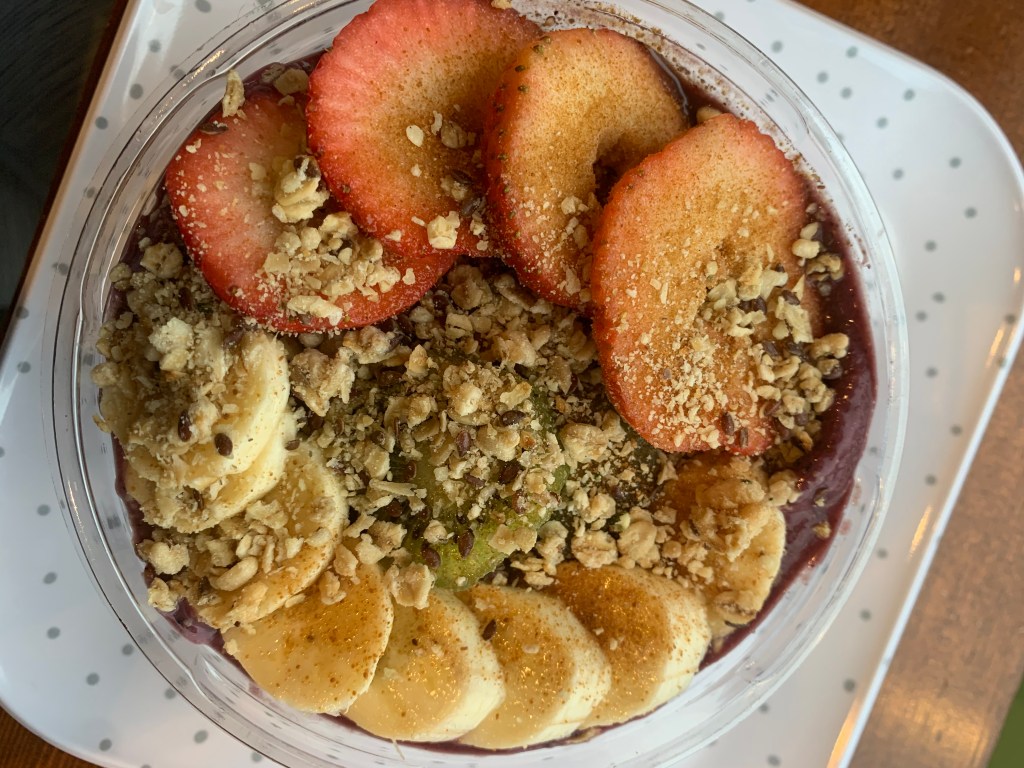
In regards to my health aspect of just living a more active and healthy life style, I feel I have started to make small progress. In the last 3 weeks, I feel proud of myself for stepping outside of my comfort zone and trying something new that I have grown to really like. Since I am exercising more, I have found that I am more mindful of the food that I put into my body. I also feel that I am sleeping better and have more energy. I actually wake up to my first alarm and just hop out of bed – its crazy. In the coming weeks, I want to cut back on weekend drinking and the snacking that is associated with it. I want to increase my water intake, and continue to find time to do things that make me feel good from the inside out, which was always my main goal! Below will be a picture of a smoothie bowl that I got after one of my first fitness classes from a local juicer in my town.

Family, Support, & Personality

Family as learned in chapter two is a key to having the skills to solve problems, express emotions, manage stress, and develop self-worth. I am proud to say that I grew up in a family that did just that, for the most part (no family is perfect). I used the love that I was given and used that to become a stronger person. In regards to my health aspect, my family has never really valued their health like I have… They enjoy more of the ‘bad’ than the ‘good’. The Support system that I have is the most important to me, and is what will help me reach all of my health goals throughout the semester and life. The chapter explains that the support from our peers becomes more and more important to us. My peers are the one who are supporting me from week to week to stick to my plans. They have signed up for fitness classes with me, making it easier to stick to. I have made a meal plan that I follow, and they know I will stick to Monday-Friday (friday night is considered the weekend). I also learned about my personality in this chapter. I draw enjoyment from the company of others, which makes sense for why the opinion of my peers is so important to me. I also demonstrate openness, so I can find comfort in myself. I think both of these are import in order to following my rule of eating 80/20 because I can be dependent on myself, as well as having people to lean on if I ever doubt myself.

Chapter 1. Mind, influence, & behavior.

Chapter one focused on rewarding yourself for the small victories, setting small and achievable goals, and how the decision we make can affect our future decisions.

Mindfulness is the chapter was explained as being “Present in the moment through greater awareness of yourself”. This included our senses, thoughts, feelings, and our environments. The chapter also explained mindfulness to be not wanting to fix or or judge what was happening around us but to just let it be. During this course, I am focusing on improving my nutrition as well as maintaining an active lifestyle in hopes to see both physical and mental changes on my body. With this in mind, over the last week I did follow the 80/20 rule of eating mainly nutrient dense food while allowing myself to give into cravings without beating myself up about it. I reminded myself that one bad decision did not erase the good ones. The chapter also explains that being mindful can improve your mental health. I started each day of the week with the good intention of staying on track, eating mindfully, and knowing that there were small goals behind each decision that I would make during the day. I’d reflect on my day, usually towards the end of it, and think if I had mainly ate 80% clean. If I did, I’d reward myself. If I did not, I would think about what I could have improved on. On the days where I did allow myself to eat less clean, I thought about what was happening around me and if anything in my environment could have caused it. This past week was a tough week, where I suffered a loss. I did choose to give in to my cravings, and I knew it was because I was having a bad day, even a bad few days. But that was okay.

Moving forward, I plan to use the preparation and action steps that were mentioned in the chapter to set my weeks up for success. I am going to set S.M.A.R.T goals and use shaping. By making a series of small changes I can develop habits that can last. Also, an action I am proud of myself for doing was improving my “self-talk”. I turned negative thoughts into plans of action. For example, I came home late from work, and really wanted to eat something healthy but had nothing prepared. I made a frozen pizza, ate the whole thing, and regretted it (but yes, it was delicious). I told myself theres nothing I can do now, but for next week I will plan to have meals ready for nights that I work late.

Introduction

Hi Everyone! I am Emily, and I am an economics major. I took this class both out of interest and because I need some extra credits for graduation! My health aspect for this semester is going to be clean eating and the physical changes it can have on your body when combined with regular exercise. I have struggled in the past with a bad relationship with food. I was unaware for a while that food is fuel. My goal for this semester is to see how beneficial clean eating is for both my body and mind. The best thing I can get out of this semester is feeling good from the inside out instead of from the outside in. I try to workout 3 times a week, but I had always struggled with eating good whole meals. It would often just be something quick here and there often just snack foods. I was getting frustrated that I would be consistently working out, and not seeing changes in my body nor my energy. I hope by the end of this, that is what changes!

I look forward to reading everyone’s blogs and learning more about what everyone is interested in.

Introduce Yourself (Example Post)

This is an example post, originally published as part of Blogging University. Enroll in one of our ten programs, and start your blog right.

You’re going to publish a post today. Don’t worry about how your blog looks. Don’t worry if you haven’t given it a name yet, or you’re feeling overwhelmed. Just click the “New Post” button, and tell us why you’re here.

Why do this?

  • Because it gives new readers context. What are you about? Why should they read your blog?
  • Because it will help you focus you own ideas about your blog and what you’d like to do with it.

The post can be short or long, a personal intro to your life or a bloggy mission statement, a manifesto for the future or a simple outline of your the types of things you hope to publish.

To help you get started, here are a few questions:

  • Why are you blogging publicly, rather than keeping a personal journal?
  • What topics do you think you’ll write about?
  • Who would you love to connect with via your blog?
  • If you blog successfully throughout the next year, what would you hope to have accomplished?

You’re not locked into any of this; one of the wonderful things about blogs is how they constantly evolve as we learn, grow, and interact with one another — but it’s good to know where and why you started, and articulating your goals may just give you a few other post ideas.

Can’t think how to get started? Just write the first thing that pops into your head. Anne Lamott, author of a book on writing we love, says that you need to give yourself permission to write a “crappy first draft”. Anne makes a great point — just start writing, and worry about editing it later.

When you’re ready to publish, give your post three to five tags that describe your blog’s focus — writing, photography, fiction, parenting, food, cars, movies, sports, whatever. These tags will help others who care about your topics find you in the Reader. Make sure one of the tags is “zerotohero,” so other new bloggers can find you, too.

Design a site like this with WordPress.com
Get started